

 English / engels
  Dutch / nederlands
[All pictures of garden wildlife on this page are thumbnails. Click on any thumbnail for a large format to be displayed.]
Beetles (Coleoptera)
No insect group counts more species than beetles do. Beetles have two pairs of wings although some species make the impression of being wingless. The front pair of wings is fully made of chitine which is extremely tough and therefore cannot be used for flying. We call them shields and one of their tasks is to protect the real wings that are located underneath the shield. If you catch a lady bug and put it on your hand pointing upwards, the lady bug run to find the highest point. When reaching the highest point it will open the shields, reveal the real wings and immediately fly away. Not all beetles have shields covering their entire body. In Western Europe lots of beetles are so-called Rove Beetles. They all have very short wing cases leaving the greater part of the body uncovered. The real wings are folded under the remains of the shields, similar to earwigs'. Oil Beetles as well as a few Longhorn Beetles also have extremely small shields.
But even though chitine may be light, insects are never very big. In beetles the maximum size is about 20 by 8 centimeters, such as the tropical Goliath Beetle, a relative of our native May Chafer. The majority of species hardly ever reaches 1 centimeter, while many species even don't reach a millimeter! The biggest species we had in our garden so far is the famous May Beetle, which reaches about 3 centimeters. On our pages the smallest beetle is Anthrenus pimpinellae, a relative of the infamous Museum Beetle. Even smaller species can be found in our garden, but most of these are too small for our camera to capture.
But even though chitine may be light, insects are never very big. In beetles the maximum size is about 20 by 8 centimeters, such as the tropical Goliath Beetle, a relative of our native May Chafer. The majority of species hardly ever reaches 1 centimeter, while many species even don't reach a millimeter! The biggest species we had in our garden so far is the famous May Beetle, which reaches about 3 centimeters. On our pages the smallest beetle is Anthrenus pimpinellae, a relative of the infamous Museum Beetle. Even smaller species can be found in our garden, but most of these are too small for our camera to capture.
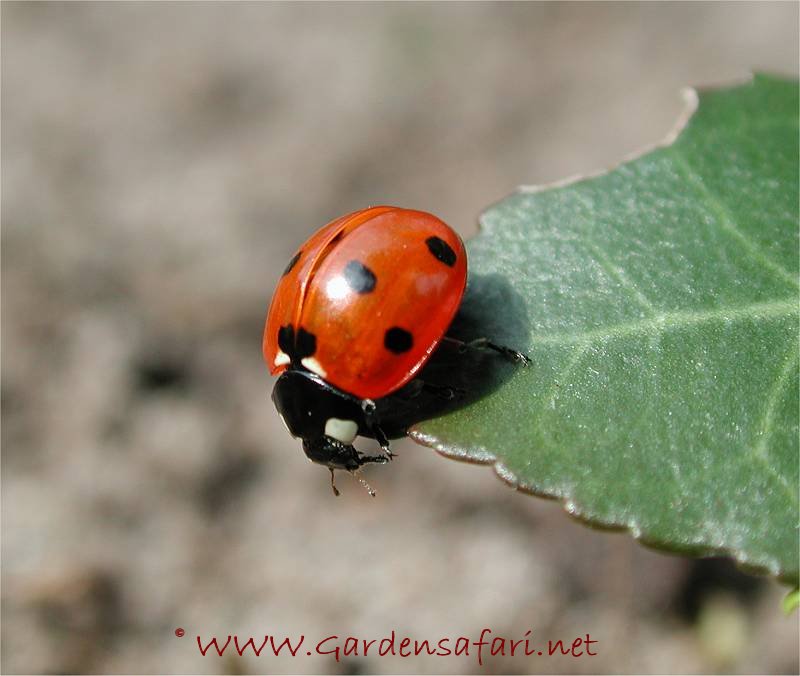
Lady Beetles (Coccinellidae)
Lady Beetles need little introduction, for they are perhaps the best known beetles. Known by many names, such as Ladybirds or even Ladybugs many people have held them in their hands. Most species are very useful, for they and their larvae hunt for aphids.
Click here to select a species.
Lady Beetles need little introduction, for they are perhaps the best known beetles. Known by many names, such as Ladybirds or even Ladybugs many people have held them in their hands. Most species are very useful, for they and their larvae hunt for aphids.
Click here to select a species.
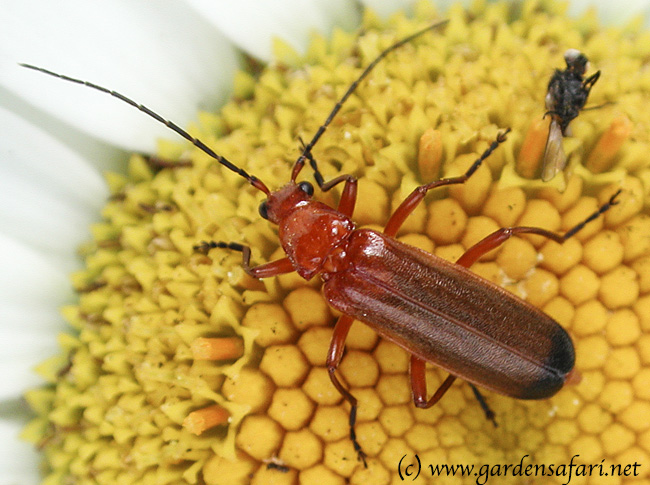
Soldier Beetles and Soft-winged Flower Beetles (Cantharidae and Malachiidae)
The Soldier Beetles and the Soft-winged Flower Beetles are two closely related families. Some representatives of these families are extremely common in gardens and along roads. The Hogwood Bonking Beetle for instance is present usually in great numbers on hogwood and other umbellifers. They do not even hide themselves, except when a thunderstorm is approaching. There are quite a number of species, all rather uniformly shaped. The species can often be told apart by looking at the colours of all body parts.
Click here to select a species.
The Soldier Beetles and the Soft-winged Flower Beetles are two closely related families. Some representatives of these families are extremely common in gardens and along roads. The Hogwood Bonking Beetle for instance is present usually in great numbers on hogwood and other umbellifers. They do not even hide themselves, except when a thunderstorm is approaching. There are quite a number of species, all rather uniformly shaped. The species can often be told apart by looking at the colours of all body parts.
Click here to select a species.

Longhorn Beetles (Cerambycidae)
Longhorn Beetles usually do have very long antennae. Almost all species are vegetarians. The larvae often live inside the stems of plants, including tree trunks. Some have a bad reputation, for they live inside dry, dead wood, such as beams and joists. After a few years the beam maybe hollow and may not support anything anymore. Actually some longhorn beetles are long lived. Dry wood is not very nutricious and it may take larvae up to 15 years to complete their development! Most species are harmless though: they live in the stem of plants, such as reet, or in rotting wood.
Click here to select a species.
Longhorn Beetles usually do have very long antennae. Almost all species are vegetarians. The larvae often live inside the stems of plants, including tree trunks. Some have a bad reputation, for they live inside dry, dead wood, such as beams and joists. After a few years the beam maybe hollow and may not support anything anymore. Actually some longhorn beetles are long lived. Dry wood is not very nutricious and it may take larvae up to 15 years to complete their development! Most species are harmless though: they live in the stem of plants, such as reet, or in rotting wood.
Click here to select a species.
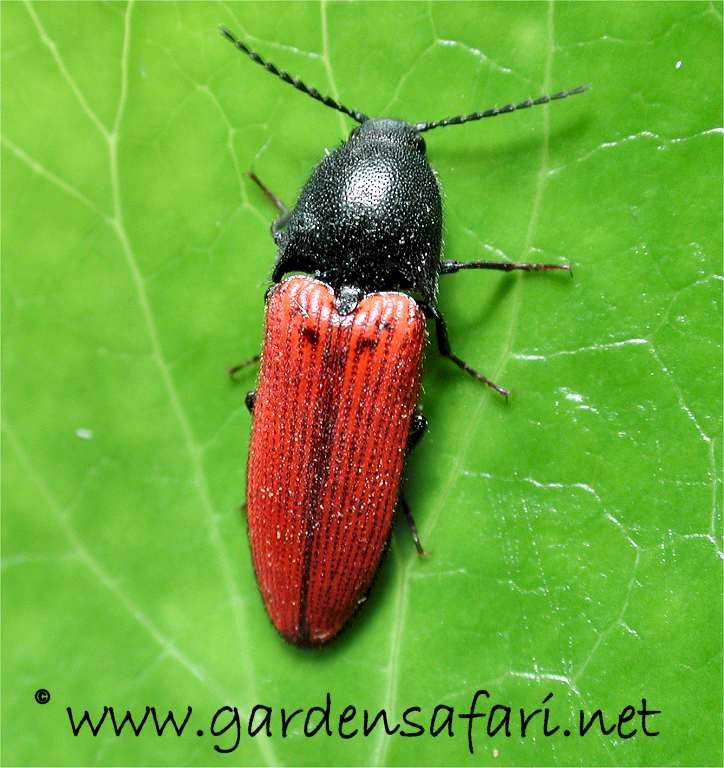
Click Beetles (Elateridae)
Click Beetles are named after the clicking sound they make when turning over after falling on their back accidentally. They all look about the same: slender, elongated bodies and a rather big, impressive neck shield. Some larvae are harmful in gardens or agriculture, for they feed on the roots of various plants. The larvae are extremely hard en move quite fast. They are commonly known as wire worms.
Click here to select a species.
Click Beetles are named after the clicking sound they make when turning over after falling on their back accidentally. They all look about the same: slender, elongated bodies and a rather big, impressive neck shield. Some larvae are harmful in gardens or agriculture, for they feed on the roots of various plants. The larvae are extremely hard en move quite fast. They are commonly known as wire worms.
Click here to select a species.

Leaf Beetles (Chrysomelidae)
Leaf beetles come in many colours and sizes, but all are vegetarians. The bigger species often are very colourful, such as the red Lily Beetle and the Colorado Beetle. The Flea Beetles on the other hand are very small and usually brownish. Many species are readily identified, but a number of black or blackish blue small species are very difficult to name. Usually knowing the food plant helps a lot. By the way the oddly shaped Tortoise Beetles belong to this family as well.
Click here to select a species.
Leaf beetles come in many colours and sizes, but all are vegetarians. The bigger species often are very colourful, such as the red Lily Beetle and the Colorado Beetle. The Flea Beetles on the other hand are very small and usually brownish. Many species are readily identified, but a number of black or blackish blue small species are very difficult to name. Usually knowing the food plant helps a lot. By the way the oddly shaped Tortoise Beetles belong to this family as well.
Click here to select a species.
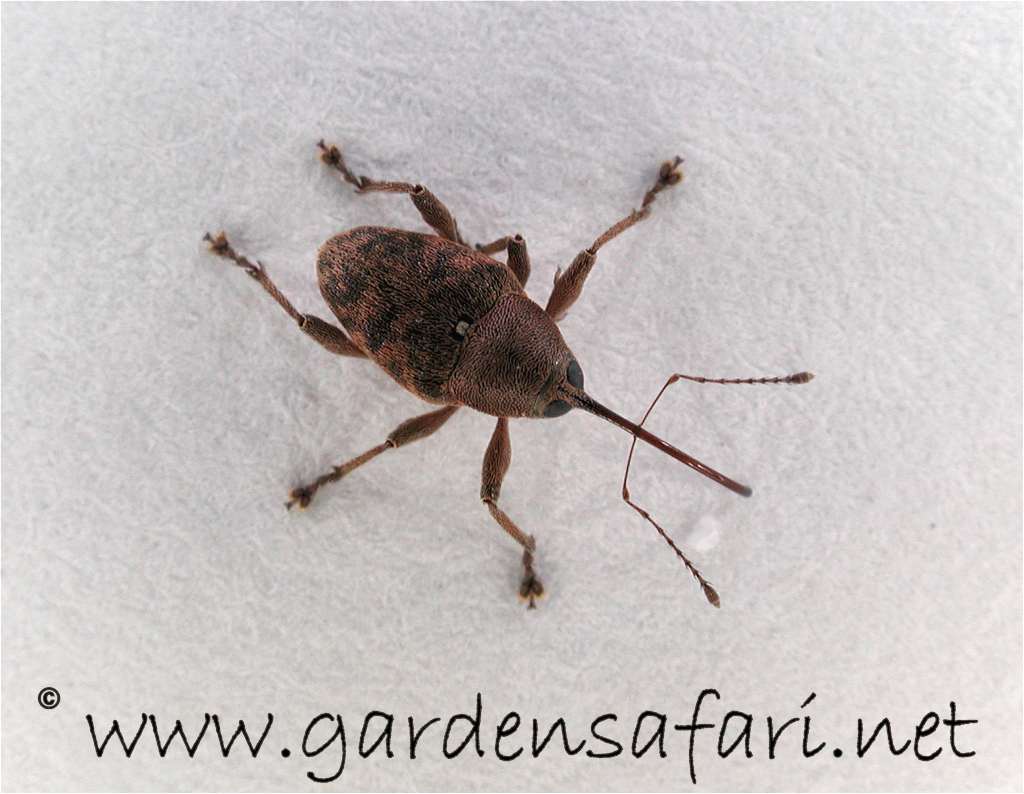
Weevils (Curcurlionidae)
Weevils - with exception of a few species - are small beetles with a long snout. Many species are also known as borers, for they deposit their eggs inside developing fruit or nuts. To do so, they drill a little hole in developing fruit. Many species are hard to identify correctly. Knowing the plants the species feed on is very helpful, for most species are attracted to a single species or genus only. By the way many species have a much shorter snout than the animal in the picture to the left.
Click here to select a species.
Weevils - with exception of a few species - are small beetles with a long snout. Many species are also known as borers, for they deposit their eggs inside developing fruit or nuts. To do so, they drill a little hole in developing fruit. Many species are hard to identify correctly. Knowing the plants the species feed on is very helpful, for most species are attracted to a single species or genus only. By the way many species have a much shorter snout than the animal in the picture to the left.
Click here to select a species.
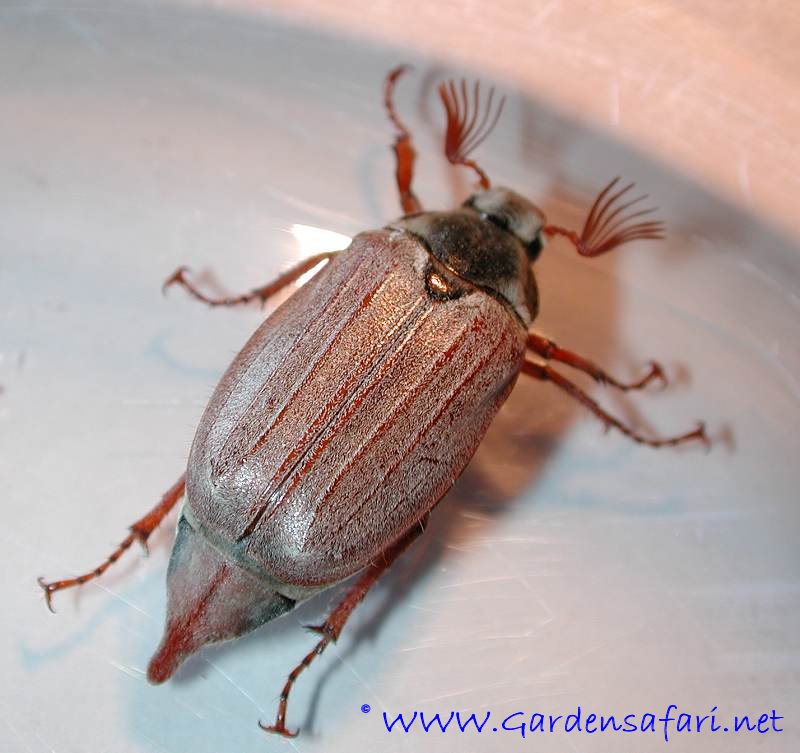
Remaining big beetles (various families)
Some families are dealt with separately. Others are divided into two groups: big beetles and small beetles. This is only done to keep the size of the pages reasonable. There is no scientific reason for this division at all. Besides there is a certain overlap. So when you can not find your beetle among the big beetles, don't forget to try the small beetle section as well. Big beetles are, among others scarab beetles, diving beetles, ground beetles, carrion beetles and chafers.
Click here to select a species.
Some families are dealt with separately. Others are divided into two groups: big beetles and small beetles. This is only done to keep the size of the pages reasonable. There is no scientific reason for this division at all. Besides there is a certain overlap. So when you can not find your beetle among the big beetles, don't forget to try the small beetle section as well. Big beetles are, among others scarab beetles, diving beetles, ground beetles, carrion beetles and chafers.
Click here to select a species.
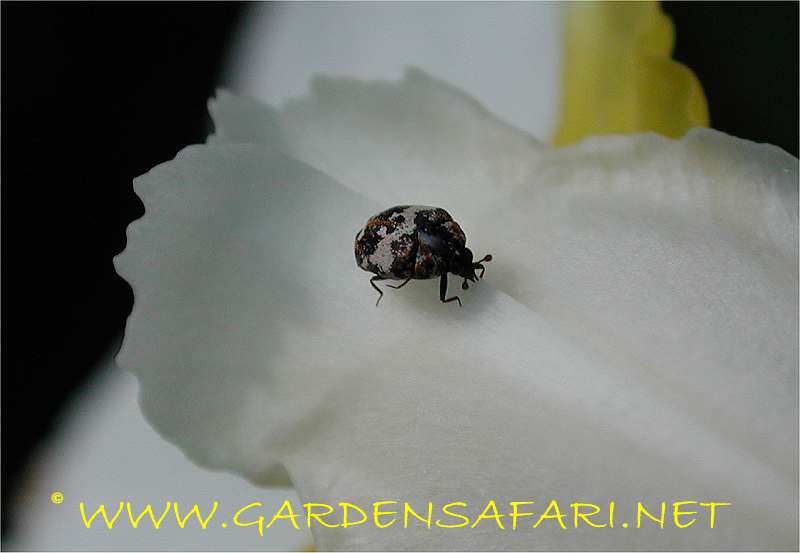
Remaining small beetles (various families)
On the following pages you will find a number of small beetles from families that have not been mentioned above. Actually they have little in common with the other insects here except for similiarity in size. Families dealt with here are Rove Beetles, Skin Beetles, Jewel Beetles, Woodworms, Tumbling Flower Beetles and Spider Beetles.
Click here to select a species.
On the following pages you will find a number of small beetles from families that have not been mentioned above. Actually they have little in common with the other insects here except for similiarity in size. Families dealt with here are Rove Beetles, Skin Beetles, Jewel Beetles, Woodworms, Tumbling Flower Beetles and Spider Beetles.
Click here to select a species.
Many beetles are beautifully coloured, while others are entirely black. Some species imitate wasps by being black and yellow, others have the same colours as the backgrounds of their habitat. Many groundbeetles are nocturnal animals and plain black. Like other insects, beetles may make their colours in three ways. The first way of obtaining colour is by producing pigments which are mixed with the chitin. In this way the colours black, brown, yellow and red are produced and all other colours from mixing the base colours mixing these colours. These animals are fast-dyed. No matter in what amount of light or what angle you look at them, they always show the same colours. The greenish and blueish metallic colours found in many insects are produced in another way. Chitin itself is transparent. Keeping it that way the light would travel through it. The structure of chitine refracts the light making an effect of green and blue shiny colours. You may compare this phenomenon to the breaking of light in a drop of oil floating on water. The structure of chitine varies from species to species giving them their own unique pattern and colours. The colours vary according to the amount of light or the angle you look at the animal. Therefore each individual has its own unique colours. We call this structural colouring. Some beetles decorate themselves in a third way: they produce colouring powder which they wear on their shields. This method is especially popular among weevils. This powder, like lipstick, wears off in time and must be renewed regularly. If not, the original colour will soon become visible at certain spots making the beetles look rather worn out. By the way: beetles are not confined to just one way of colouring. They may use all methods at the same time which explains why many black beetles have a blue or green cast especially visible in sunshine.
The chitin turns beetles into hard nuts to crack and is a very good protection from certain enemies. Yet a suit of armour like this has one disadvantage: it will not allow you to grow any bigger. That's why insects have a larval state. Larvae do not have a hard chitin skin and therefor may grow bigger. Their skin is rather soft and is changed each time the insects wants to grow bigger. Even though a beetle goes through the full cycle of development: egg-larva-pupa-imago, it may only grow bigger in the larval state. An extremely small May Bug is not a young animal as some believe, but an animal that suffered from lack of food during the larval state. Once out of the pupa, the insect has reached its biggest size! In the suite of armour there are just a few openings allowing the animal to live: the mouth, through which food is absorbed, the excretion hole at the back to get rid of useless stuff and the trachea, very small openings, usually on both sides through which air is inhaled. Insects do not have lungs. They simply inhale by means of these thrachea, tubes through which the air is transported into the body. The tubes get very narrow allowing oxygen to reach all cells of the body.
One of the frequently asked questions about beetles concerns their age. How long does a beetle live? It is a very tough question to answer. Usually the question refers to the adult beetle, but that's unfair. The entire lifespan of a beetle consists of the four stages: egg-larva-pupa and adult. The period of time spent in the egg stage is not taken into consideration. Like in birds, an insect is supposed to be born at the moment it crawls out of the egg. So we have to measure an insects' life span by measuring how long it lives from the moment it comes out of the egg to the moment it dies. But even then things get very complicated. A May Bug for instance may live for merely two years or just as well it may reach the respectable age of 8 years. When conditions are optimal, the development of the larva takes just two years. When food is scarce or not very nutricious it may take the larva 5 years to pupate. Then, when the adults crawl out of the ground they usually live for about 4 to 5 weeks. Females will live a little longer than males because after mating the eggs need some time to ripen in the body of the female. By then the male is already dead after having fulfilled his duty.
In captivity an adult of May Beetle can live much longer provided it is deprived of a possibility to mate. If you take a good care of a newly born May Bug it can keep you company for as long as three years! As soon as the male mates it dies within a couple of days. Females die right after depositing the eggs. In Western Europe there are only very few beetles that live for over a year as an adult. Some brown weevils do that but all others will die relatively quickly. Moreover our mild winters force most insects to overwintering. There is not enough food for all animals to feed so all bodily functions are suspended and the animals wait for better times to come. In southern parts of Europe and in Northern Africa the hot and dry part of summer are more of a challenge to beetles than winters.
So, how long do beetles live? In some cases, as in many skin beetles, the whole lifecycle will take no more than three to four weeks. Some longhorns live on dry wood which can hardly be considered nutricious diet. They may live inside a tree or joist for as long as twelve years before crawling out as an adult. However the adults hardly ever live over six months (not counting overwintering or oversummering). So generally speaking the life span of a beetle in moderate Europe varies from anything between three weeks to twelve years!
Thanks to David Gould (UK), Johan Bogaert (B), Kees van der Krieke (NL), G. Sama (GB?), Frank Köhler (D), Adrian Ruicanescu (GB), Craig Phillips (GB), Boris Büche (D), Rob Westerduijn (NL), Arved Lompe (D), Christopher Majka (CA), Otto Merkl (H), Vitali Nagirnyi (Est), Denis Keith (F), Schott Laurent (F), Victor Shilenkov (RU), Keith Edkins (UK), Guido Bonamie (B), Bertin Boertjes (NL), Arie M. den Toom (NL), Gerrit Tyberghein (B), Jan Muilwijk (NL) en Hans Ehrenhard (NL) for helping with identifying various species.


© Copyright 1998-2024 gardensafari.net (Hania Berdys)